Page 13 of 15

Rowing Warmup: The Complete Guide

The warmup is an important time to set you up for the best rowing, erging, or strength training session with the lowest risk of injury. You can do a solid full-body rowing warmup in 10 minutes, or 15 minutes if you include the light aerobic time. In this article, we’ll cover my go-to rowing warmup movement sequences so you can start making this a part of your training right away.

Key Points: The rowing warmup prepares the body to generate and transmit force from good positions in rowing, erging, or strength training. Rowing is a long range-of-motion sport requiring performance from challenging physical positions  at high outputs, for long durations, and under high fatigue. To make this harder, rowers are often rolling out of bed 30 minutes before an early morning practice or sitting down all day at work or school before an afternoon or evening practice. Use these movement sequences for 10 minutes of physical preparation to get more out of your training with less risk of injury.

Table of Contents:

Continue reading → Rowing Warmup: The Complete Guide

home gym for rowing

Building a Home Gym for Rowing Training

I’ve been living the home gym lifestyle for a few years now, enjoying the flexible hours, dog-friendly policies, whatever equipment I need for my goals, and no lines waiting to use it. Here is my list of priority and preferred equipment, as well as some tips and tricks for building your home gym for rowing and strength training for rowing. I have also included links to additional resources and exercise demonstrations for specific pieces of recommended equipment.

Key Points: The biggest question of home gym equipment is determining what you will actually use. There’s no point having the best equipment just to turn it into a clothes hanger. If you’re open to my recommendations, my first priority is some sort of weights for adding external load to strength training exercises, plus mats to cushion the weights and a power rack or squat stand to support heavier barbell training. Resistance bands are great for a wide range of exercises from inexpensive, storable, portable equipment. If you have the space and budget for additional equipment, a trap/hex bar, dumbbells, kettlebells, an adjustable weight bench, a TRX or gymnastics rings, and a glute-ham raise are all on my list of worthwhile acquisitions for rowers.

home gym for rowing

Continue reading → Building a Home Gym for Rowing Training

Why I Hate the Bench Pull for Rowing

I hate the bench pull for rowing strength training. I can see a justification for most other exercises, but the bench pull is one of the few exercises I’ll do everything I can to avoid using in my strength training for rowers. This is a controversial opinion in rowing, especially among more “old school” coaches and rowers who remember the lift with mythical status of the 1970s, 80s, and early 90s. I’ll use this article to state my case for why the bench pull should be left behind in the modern era of rowing, what exercises I use instead of the bench pull, as well as how to modify the bench pull to be a more effective, safer exercise for those who must bench pull.

Key Points: Bench pull rowing enthusiasts usually tout the exercise’s specificity to the rowing stroke, but I see it as anything but specific. Rowers rowing on the water or on ergs do not lie facedown on a solid object and pull with their arms in a straight line against a static object. Rowers execute a refined movement to place the blade in the water (a dynamic target), initiate force with the lower body, transfer it through a torso in the hinge position, and complete the stroke in a dynamic, smooth motion with the upper body muscles. My biggest problem with the bench pull is the direct pressure on the ribcage as a known risk factor for the common and costly rib stress injury. Rowers should use other horizontal pull exercises like bodyweight rows, single-arm rows, and a few more variations rather than take on such risk for such little benefit as the bench pull for rowing performance.

Table of Contents:

Continue reading → Why I Hate the Bench Pull for Rowing

10 best exercises for rowing cover image, barbell and text

The 10 Best Strength Training Exercises for Rowing

This is what I would do if I could only do 10 exercises for rowing strength training. In reality, I use more variations of our basic exercises of the squat, hinge, push, and pull movements, plus exercises for the core, shoulder, and hip muscles. However, these 10 exercises are a great starting point for strength training for rowing. In this article, we’ll go through each one with how it improves rowing performance, reduces risk of common rowing injuries, and how I use it in my rowing strength training programs.

Here’s a brief overview on my rowing strength training philosophy to set up these exercises. Rowers need strength training for the muscles that contribute to rowing performance to increase force output in the rowing movement. Rowers also need strength training for the non-rowing muscles that are underdeveloped by the rowing stroke to improve muscle balance and reduce risk of injury. We do some form of strength training year-round in my coaching with rowers of all ages, types, and levels. We build strength, power, and muscle mass during “off-seasons” or times of decreased rowing training and racing. We then train to maintain strength, power, and muscle mass when we focus on rowing performance during “in-season” or race prep training.

We’ll stick to the exercise details in this article, but I’ve written a lot about how to combine the exercises in a strength training program elsewhere on my website. Start with “The Basics of Strength Training for Rowing” and read on from there.

10 best exercises for rowing cover image, barbell and text

Continue reading → The 10 Best Strength Training Exercises for Rowing

Mastering the Hip Hinge for Rowing

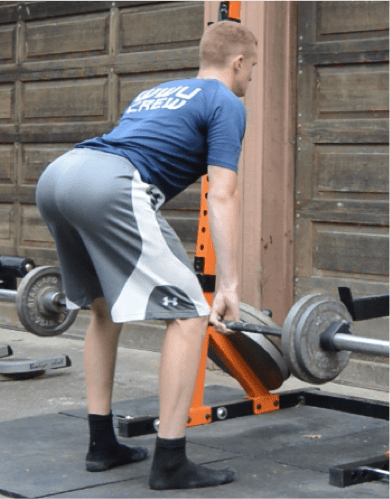
hip hinge for rowingThe hip hinge for rowing is a key basic athletic movement that must be mastered to perform many strength training exercises in the weight-room to improve rowing performance. Squat, deadlift, push press, and Olympic lift variations all rely on the fundamental ability to hip hinge. Plus, a rock-solid hip hinge for rowing is the key to achieving reach in the stroke and power on the drive through the hips, rather than through the spine. The hip hinge is key to improving rowing performance as well as reducing low back pain injury, and it can even help reduce risk of rib stress injury. But more on that later! The hip hinge is the basis of the fundamental athletic position, but many rowers miss this part of early training and have to learn it for the first time later in their career.

Continue reading → Mastering the Hip Hinge for Rowing

Fixing Rowing Imbalances in Off-Season Training

The general preparation block is one of the most productive training times to set up the rest of the year of training and performance. This is generally the off-season phase of training furthest away from the main competitive season. For 2km-focused rowers racing in the spring season, the general preparation block would be the summer season. This is a crucial time of training to build the aerobic base and muscular foundation that the rower will draw on for the rest of the year. Fixing rowing imbalances is also a major goal of this block. The main goals of the general preparation block are:

  1. Rest, recover, and heal
  2. Build a foundation of strength and aerobic fitness
  3. Fix rowing imbalances
  4. Enjoy the off-season and maintain your enthusiasm for future hard training

Continue reading → Fixing Rowing Imbalances in Off-Season Training

Off-Season Rowing Strength Training

The racing season has ended, the final races rowed, and you’re ready to start down the road of off-season training. The off-season is a crucial time to set yourself up for the rest of the year. In this article, we’ll cover the major goals of off-season rowing strength training, general program guidelines, and example strength training programs for openweight, lightweight, and masters rowers.

This article is Part 1 in my strength training for rowing annual programming series. Read “The Basics of Strength Training for Rowing” for the general overview of the annual strength training plan, and then individual block-by-block articles after this one for Part 2 Specific Prep, Part 3 Pre-Season/Pre-Competitive, and Part 4 In-Season/Race Prep.

Table of Contents:

Continue reading → Off-Season Rowing Strength Training

Staying Summer Fit for Rowing

It’s summer time and many of us are thinking of time away from the boathouse, ergometer, and spin bike. Often, this is out of our control, such as in the case of the high school student who has a summer job that conflicts with open gym or boathouse times. Sometimes this is in our control, such as a planned vacation or conscious choice to move rowing to the back-burner for a few weeks or months and focus on other activities. The competitive athlete will never want to give up an edge to their competition, so while there is no true replacement for time in the boat or on the erg, here is how to stay summer fit for rowing so you maintain as much strength and fitness as possible to make smooth the transition back to specific training.

A Rowperfect reader asked, “I’m unable to row for the next month and I can only really use the erg (and for that matter, weights) a few times a week. Other than that, what are good methods for keeping rowing fit?

Continue reading → Staying Summer Fit for Rowing

transitioning from sport

Athlete Transitioning from Sport

Often lost in the excitement of the final races, championship qualifiers, and preparing for the culmination of another season is the realization that, for the hundreds of thousands of athletes graduating from high school or college and not continuing sport, this is it. While transitioning from sport for rowers means sleeping in, no more erg tests, and a life beyond spandex, many will struggle to adjust to a life that does not revolve around athletics and athletic performance. Sports have special cultures and forge strong bonds between teammates, and many will not find the close relationships that existed between teammates in work, school, or future life. Coaches and athletes must be prepared to handle this transition for the long-term success of our athletes and sport.

Sport unites us around a common goal and shared effort. Beyond the medals and trophies, this is one thing that makes sport so valuable in a person’s life. When retired athletes look back on their career and what they enjoyed, it’s usually much more about the lifelong relationships and personal accomplishments than the stat lines, number of games won, or trophies earned. These deep bonds between teammates who share the memories, work ethic, intrinsic motivation, and dedication are hard to match later in life.

This is also what makes sport so hard to leave, and why retirement from competitive, organized sport can be so difficult on so many people. Everyone who has ever picked up a pair of cleats, glove, ball, or an oar, has had or will have to retire someday. For some, transitioning from sport is a choice made voluntarily when the athlete feels they have reached a personally satisfactory level of accomplishment in their career, or chooses to pursue other goals. For others, that moment comes too soon. Involuntary transition can be caused by injury, aging or graduating out of competitive sport opportunities, relocating away from their team or sport, or not making the tryout cut for further competition. Regardless of the reasons, every single athlete at some point has to deal with the sense of loss that comes from leaving sport behind. There is a lot that we can do as coaches and athletes to improve the smoothness of transitioning from sport, and continue to have a beneficial effect on our athletes’ lives even after they’ve left our program.

Table of Contents

transitioning from sport

Continue reading → Athlete Transitioning from Sport

core training for rowing

Core Training for Rowing: Research and Practice

Rowers love “the core,” but what exactly is the purpose of this muscle group in rowing performance and how can we train it most effectively for faster times, better technique, and reduced risk of injuries? The purpose of this article is not to convince you to do core training for rowing, because you probably already are! Instead, we’ll discuss some key features of core anatomy and training, explore some relevant rowing research, and I hope to introduce you to a few exercises beyond planks and crunches to add to your core training for rowing.

Key Points: “The core” includes more than just the “six-pack” rectus abdominis muscle and core training for rowing should include movements for the other abdominal muscles and the posterior trunk muscles around the lumbar spine. Static plank holds are fine for an entry point into basic strength training, but the core muscles do not act statically in the rowing stroke. Rowers need to progress to exercises involving more movement at the extremities and hips with a stable spine for core strength to carry over to improved performance and reduced risk of injuries. Watch detailed video demonstrations of the TRX/gymnastics ring suspension trainer core exercises and my favorite core exercise for rowers, the seated rockback. These exercises offer many different variations and progressions to keep core strength training engaging and effective for rowers of all ages, types, and levels.

Table of Contents

core training for rowing

Continue reading → Core Training for Rowing: Research and Practice